


Technical
How they work
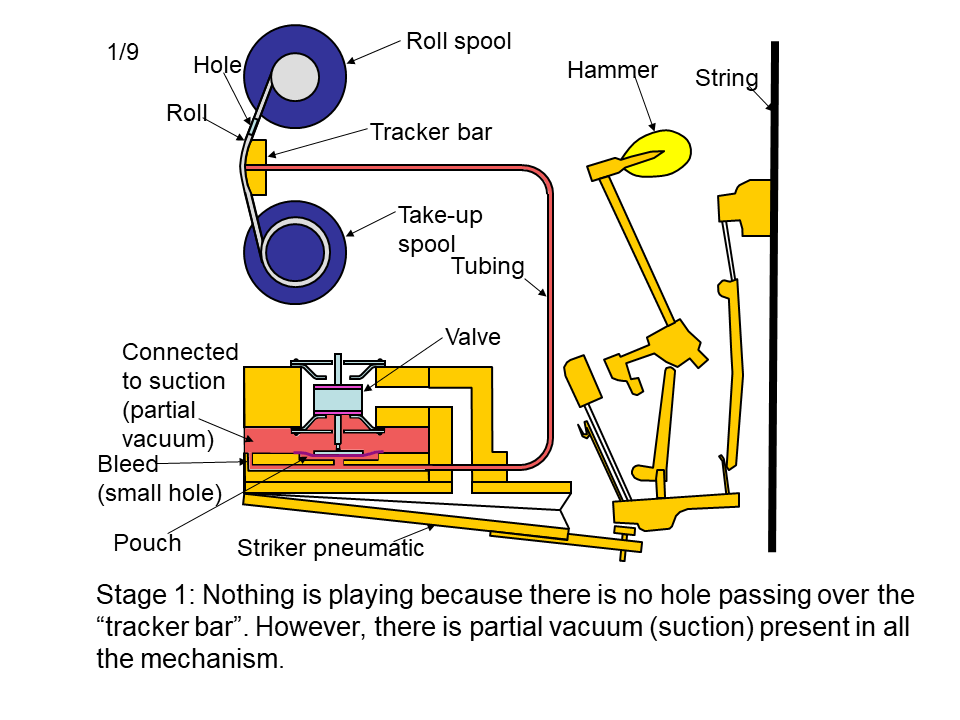
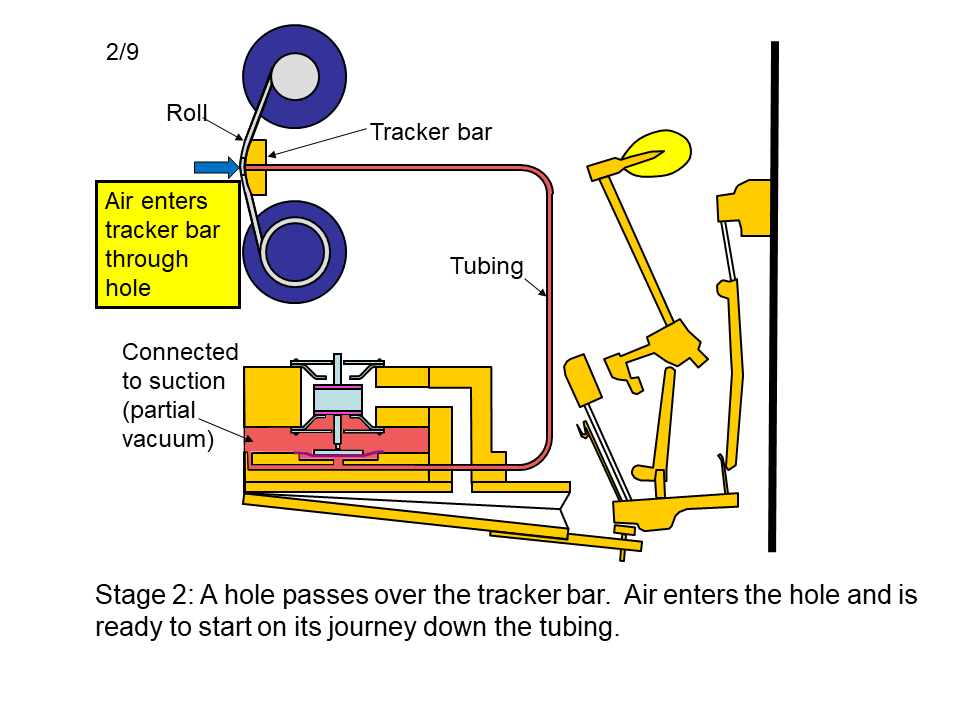
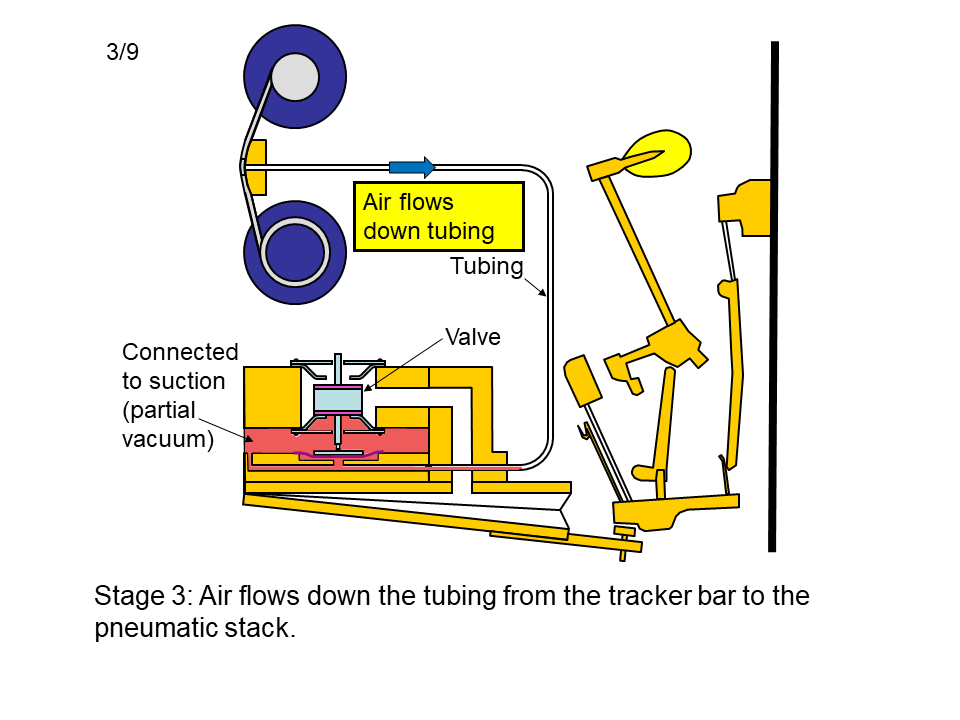
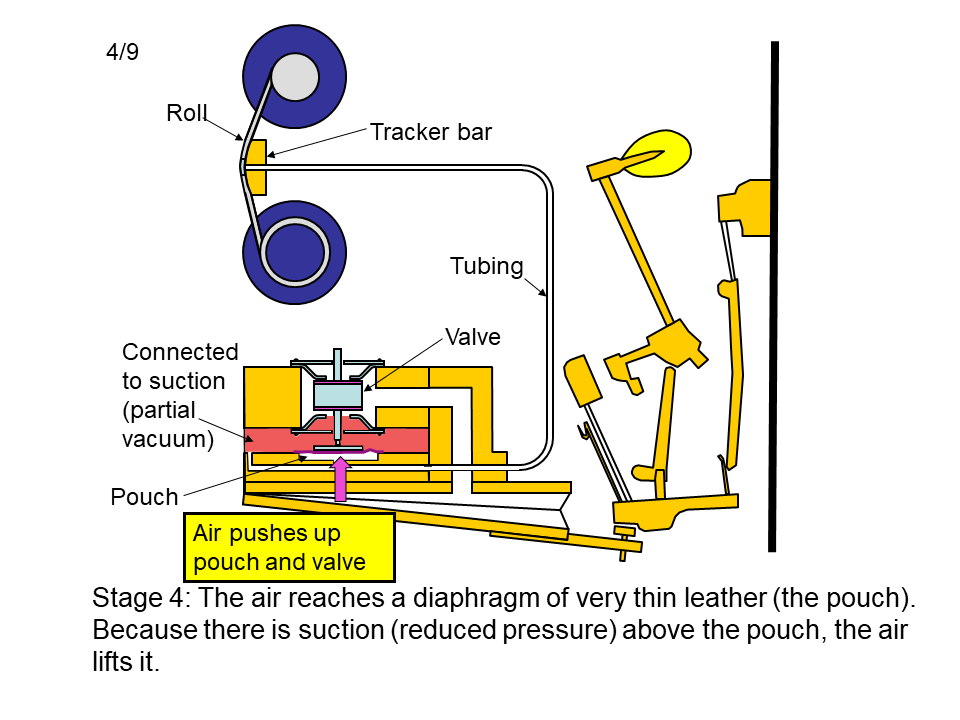
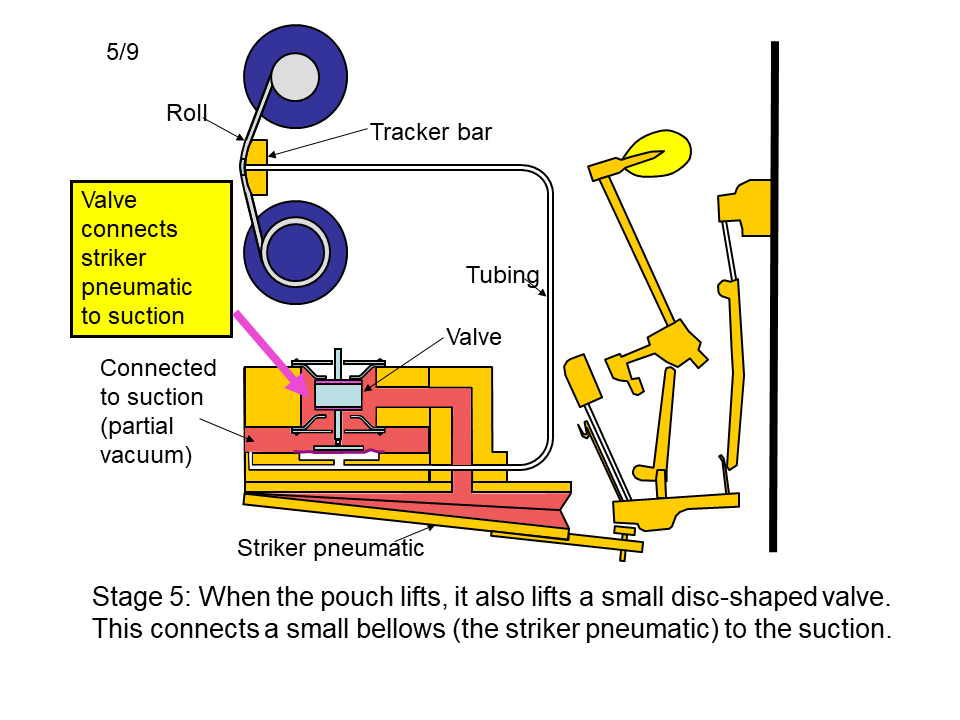
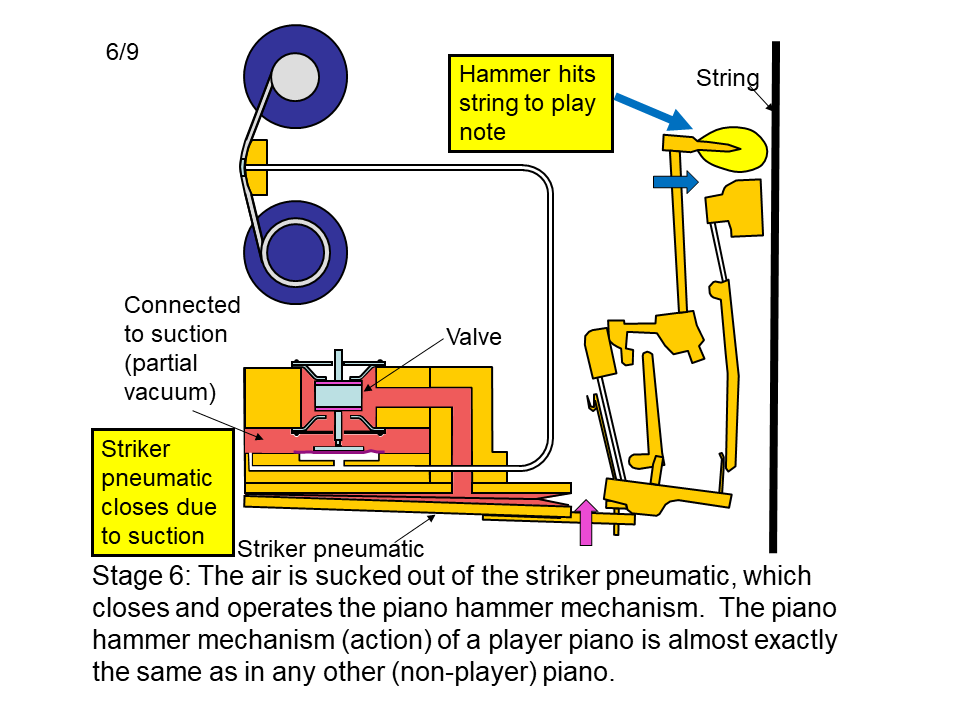
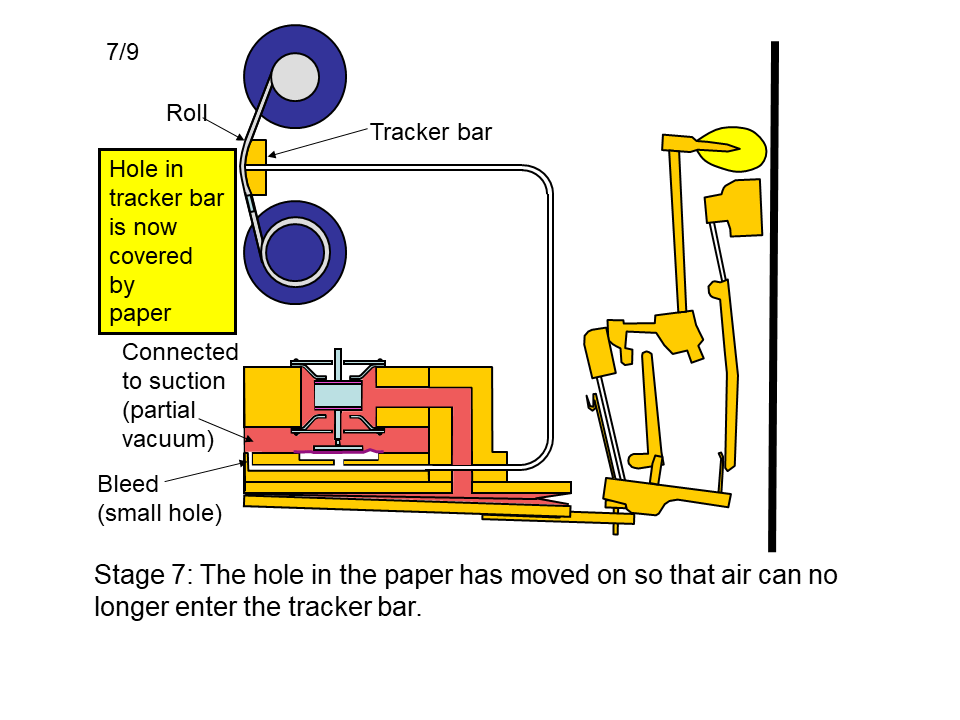
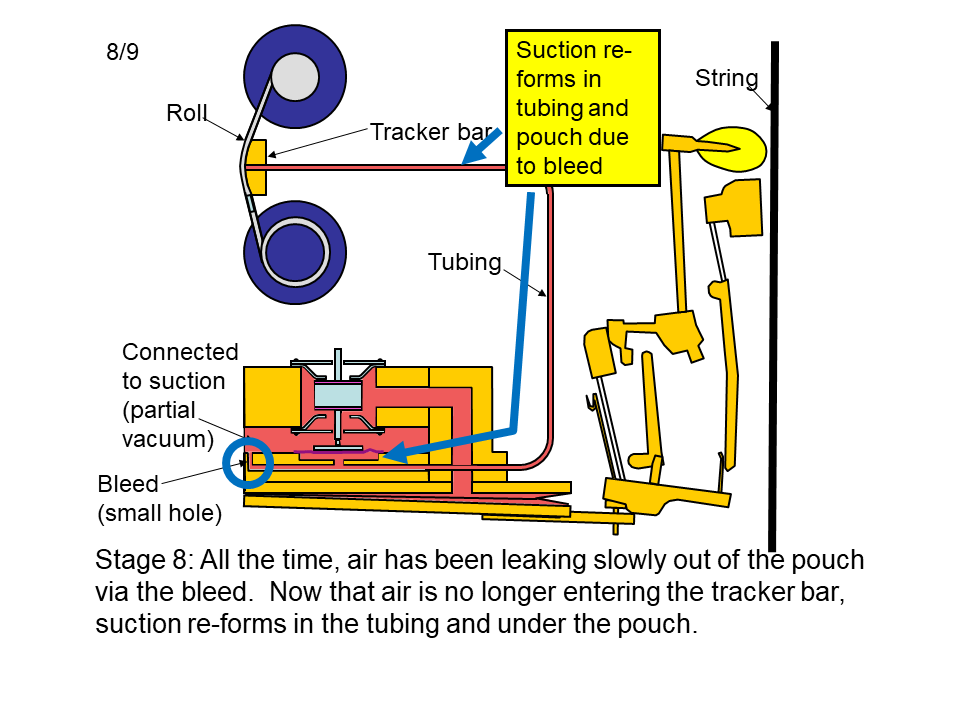
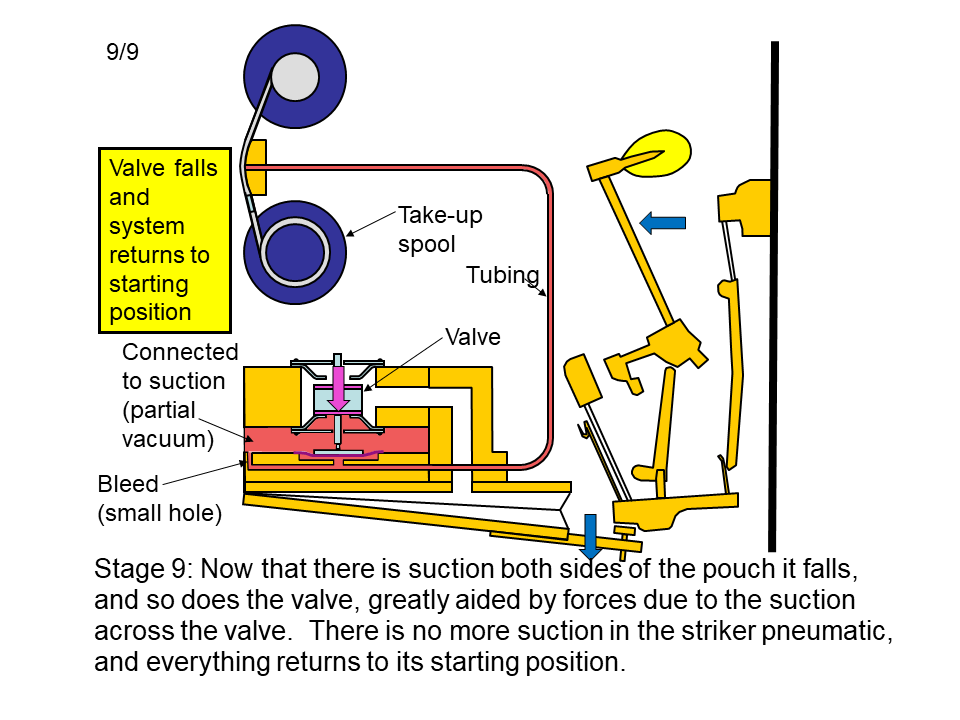
The sequence of web pages which follows forms a simple animation of how a straightforward “Pianola” plays reads the roll and plays the notes.
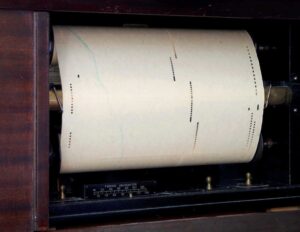
The picture below shows the roll passing over the brass “tracker bar”, with the perforations resulting in notes being played whenever the perforations uncover a hole in the tracker bar. Air can then enter the hole in the bar and operate the mechanism, as explained below.
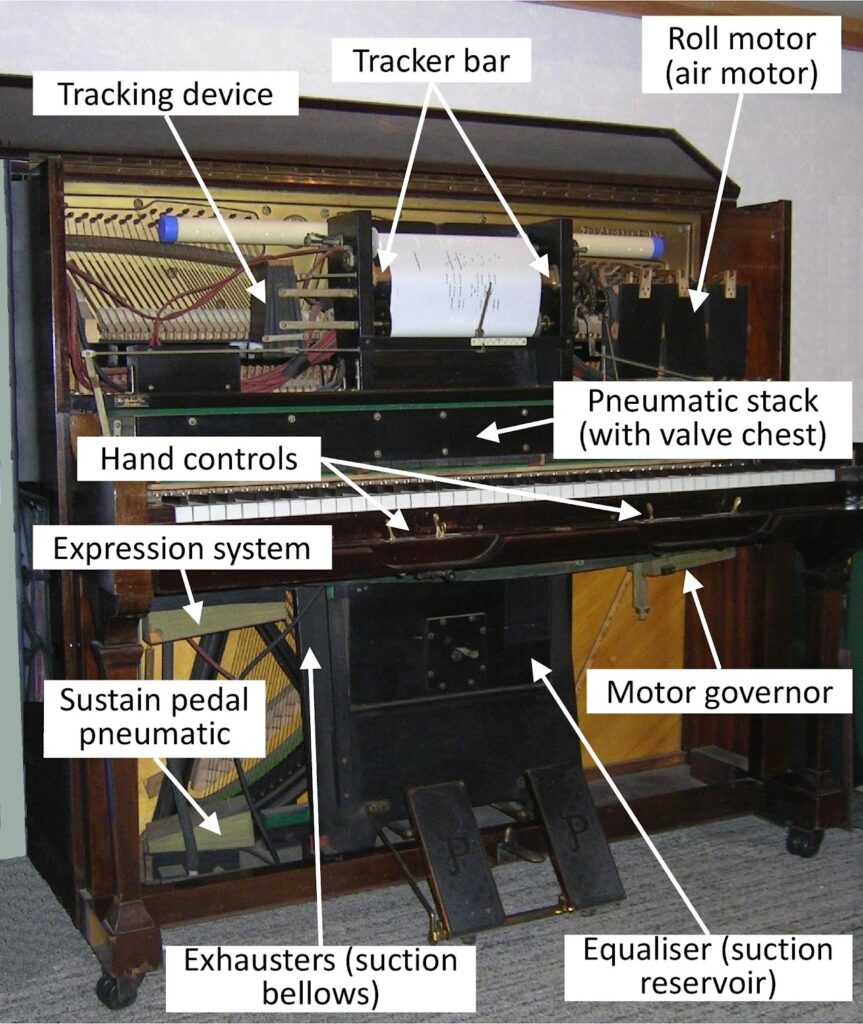
The system runs on suction (partial vacuum) which in a conventional pianola is created by pumping the foot pedals. To play loudly, pump hard, to play softly, pump less hard. The picture below shows inside a typical player piano, and shows the main components.
The sequence of images below show what happens behind the scenes as the mechanism causes the notes to operate. Make sure you can see the captions above the images, click the > and < arrow buttons to move forwards and backwards through the sequence. (Note: this sequence is best viewed on a laptop or desktop computer, it is not optimised for mobile devices or tablets).
What are they?
These were the luxury models aimed at the more affluent classes and were the top-end “hi-fi” systems of the player piano era; they were much more sophisticated than the straightforward foot-pumped player pianos and came with a price tag to match. There were various systems e.g. Duo-Art, Ampico, Welte (of which there were three variants) and various other less common ones (e.g.Artrio-Angelus, Triphonola). They play specially-adapted rolls which are recordings of actual performances of pianists, and include special coding in the margins of the rolls to play the music with all the loud-and-soft expression. Many famous pianists (including Rachmaninov, Paderewski and Rubinstein) recorded reproducing piano rolls, mostly during the period 1905-1930. The quality of gramophone recordings only reached an acceptable standard in the mid/late 1920’s and until then often involved serious distortions to the playing style to get a usable recording, so these piano roll recordings are often a more faithful likeness of early 20th century pianists’ playing than their sound recordings.
How do they work?
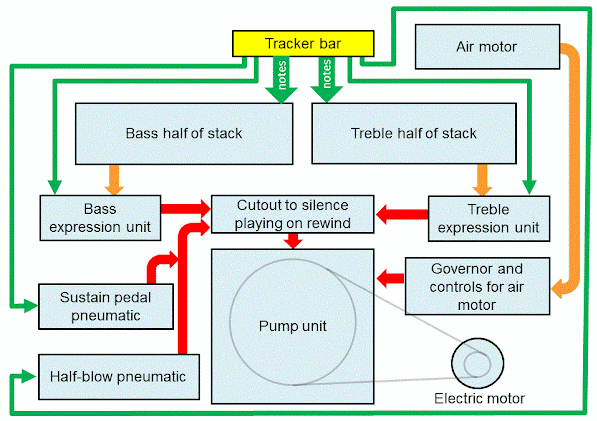
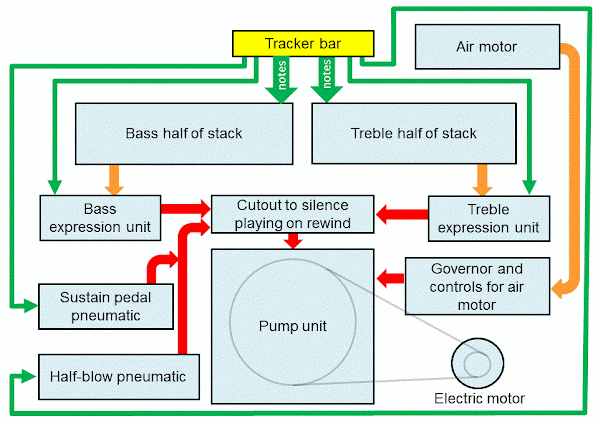
The basic method of playing the notes is identical to that of the straightforward player piano as explained elsewhere on the website. They are still operated by air, under the control of a paper roll, but the air is pumped either by a set of electrically-driven bellows or by a “Motora” high-speed rotary pump. Variations in tempo, pauses, breaking of chords etc. are all contained in the note perforations of the rolls, which directly contain the keystrokes of the pianist, while additional perforations in the margins of the roll (typically using tracks borrowed from the top and bottom few notes) contain special coding which controls the dynamics (loud and soft expression) by varying the level of suction applied to the player mechanism, along with control of the piano’s sustain (loud) and half-blow (soft) pedal. This diagram shows the basic layout of a typical reproducing piano.
However, the methods by which the dynamic perforations are converted into different levels of suction vary drastically from manufacturer to manufacturer. In the UK, the Duo-Art system is the most common, the Ampico Model A system less common, Welte systems are unusual and other systems (Ampico B and others) are relatively rare. The following brief descriptions are reinforced with simple frame-by-frame descriptions and animations.
Reproducing Systems in Detail
The Duo-Art was the reproducing piano system produced by the Aeolian Corporation, and like the Ampico and Welte was designed to reproduce an actual performance by a pianist which had been recorded on special equipment, with the note intensity values being encoded in (essentially) four-bit binary code within Duo-Art rolls: four bits for the theme intensity and four bits for the accompaniment, with theme and accompaniment being assigned to bass and/or treble as require. Duo-Art rolls are of standard width and spool design but have additional coding in the margins. There were actually three main variants of the Duo-Art system, two of which were capable of being used as true reproducing pianos, with the third being essentially a pedal pianola with enhanced expression:
The electric-only Duo-Art: this is designed to operate purely as a reproducing piano, though with some capability for playing non-reproducing rolls without expression.
The Pedal-Electric Duo-Art (PEDA): this is a dual-purpose instrument capable of being configured either to operate electrically as a reproducing piano, or to be used as a conventional pedal-operated player piano. The PEDA makes for a very versatile and desirable instrument; it was however primarily a product of Aeolian in the UK and is virtually unknown in the USA where only the electric-only Duo-Art (and standard pedal-operated pianolas) were available.
The pedal-only Duo-Art (Pedal Duo-Art often known as the half Duo-Art): this is very similar to a conventional pedal-operated pianola but instead of a standard expression box it has a single Duo-Art regulator as shown in the technical explanation below. This controls the accompaniment level (in other words, the non-theme notes forming the background to the music) while the theme is automatically picked out at the level controlled directly by the pedalling of the pianolist. It was arguably something of a ploy to create a market for the expensive Duo-Art rolls among people who could not afford a full electric or pedal-electric instrument.
The following sections explain how the Duo-Art system reads the notes from the roll and plays them at the level specified in the special coding in the roll margins.
How the Duo-Art works: Introduction
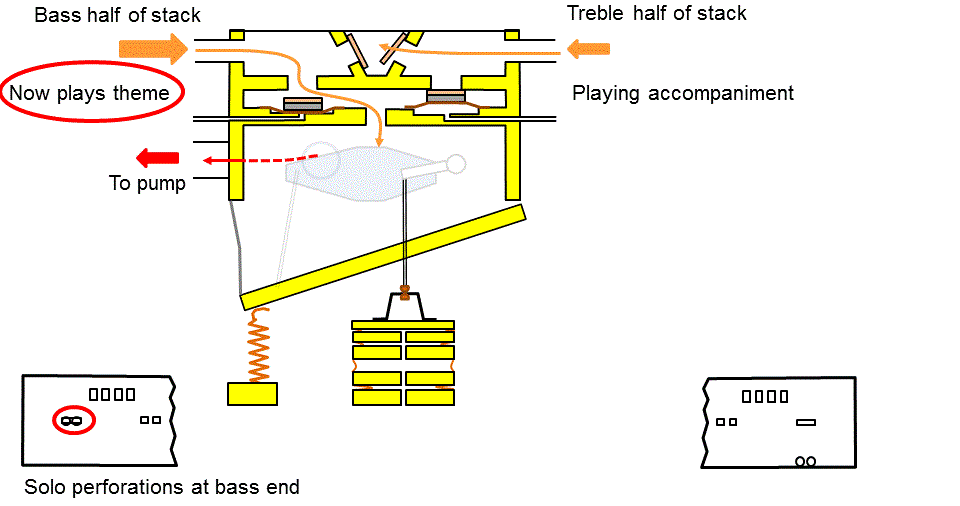
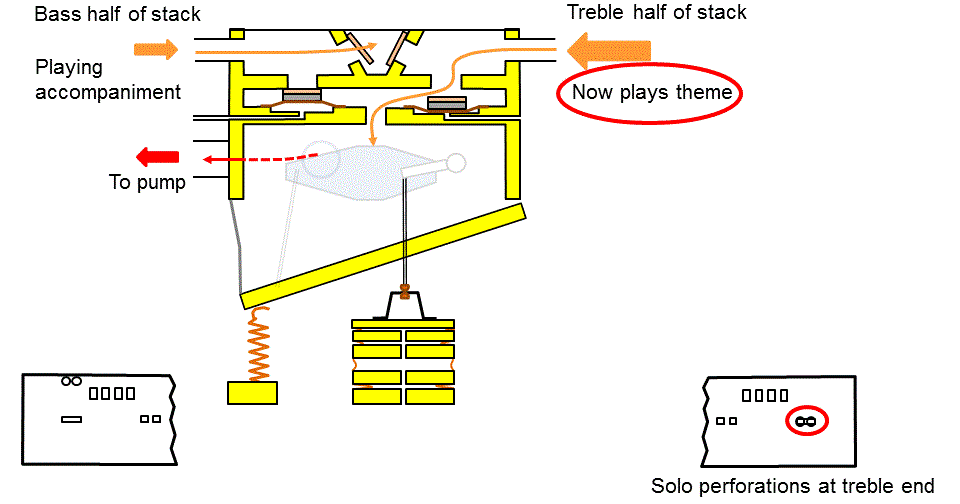
The Duo-Art system has a single expression box which supplies both halves of the player stack at two alternative levels of playing: “theme” (for bringing out the melody or foreground of the music) and “accompaniment” (background level of playing). The expression box has suction regulators for setting both of these levels, and a valve system for connecting either or both halves of the stack to the theme regulator (by default they are both driven from the accompaniment regulator).
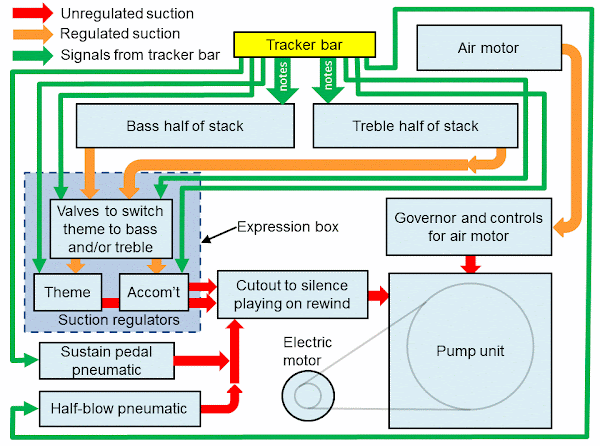
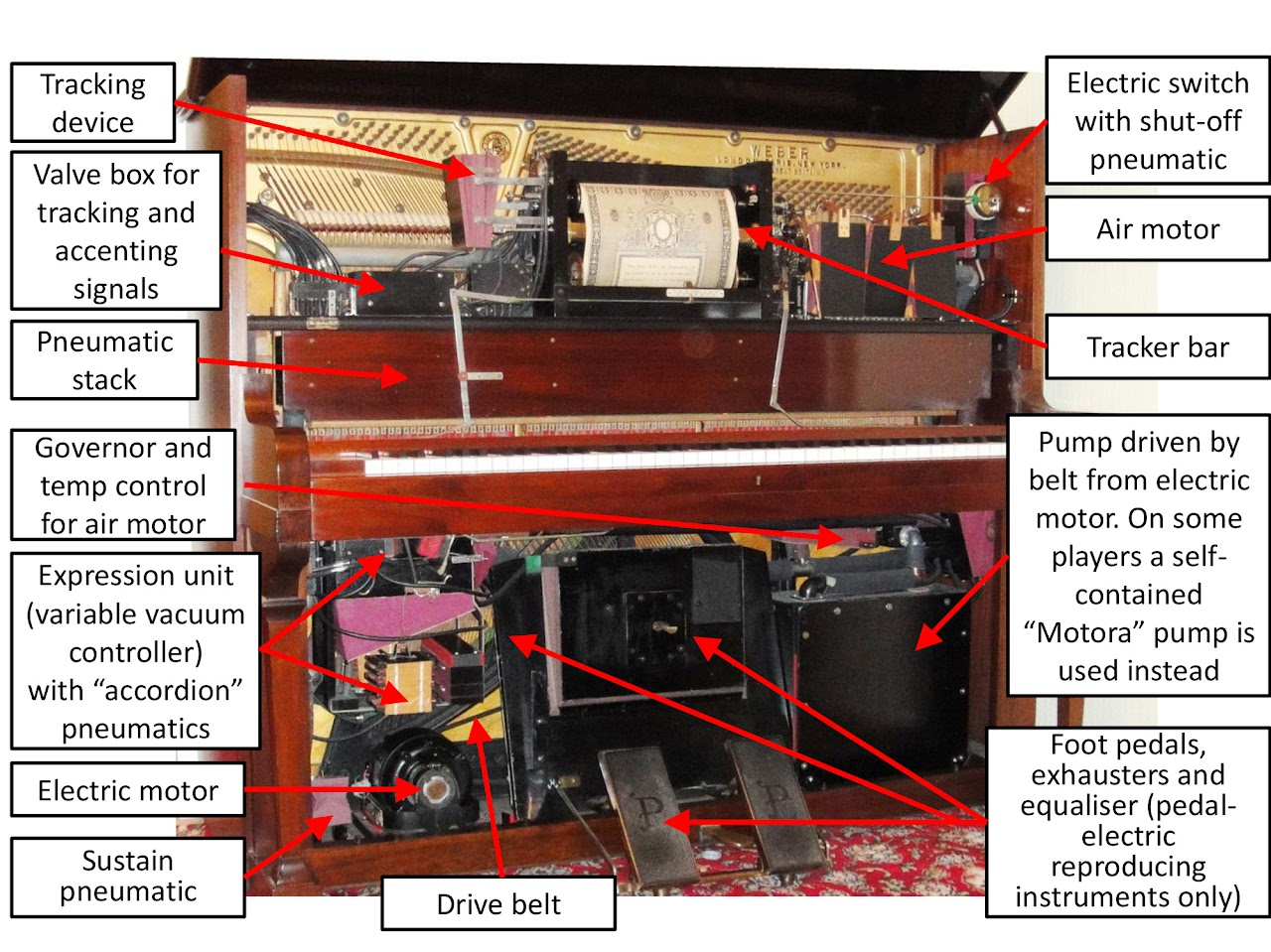
The diagram above shows how both halves of the stack are connected to the single expression box, and the picture below shows the inside of a Pedal-Electric Duo-Art reproducing piano with the main components labelled.
How the Duo-Art expression box works
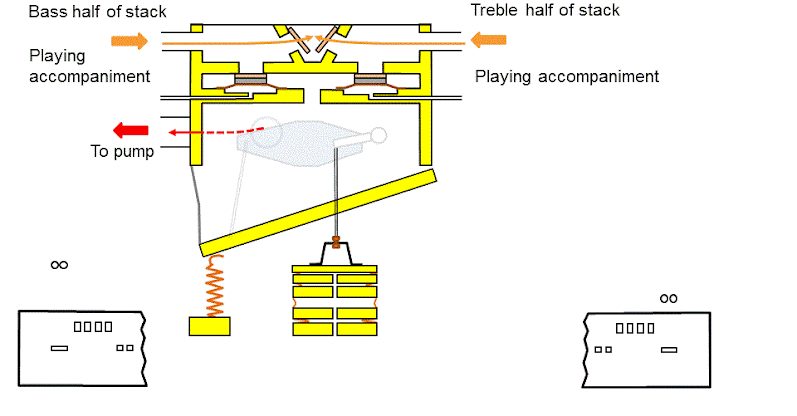
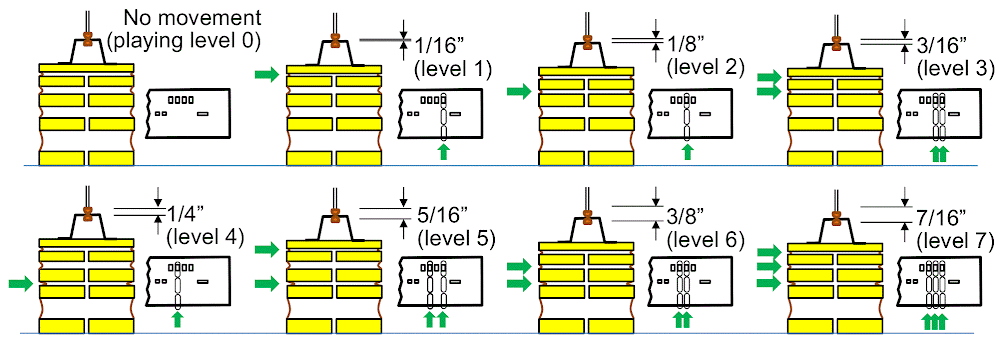
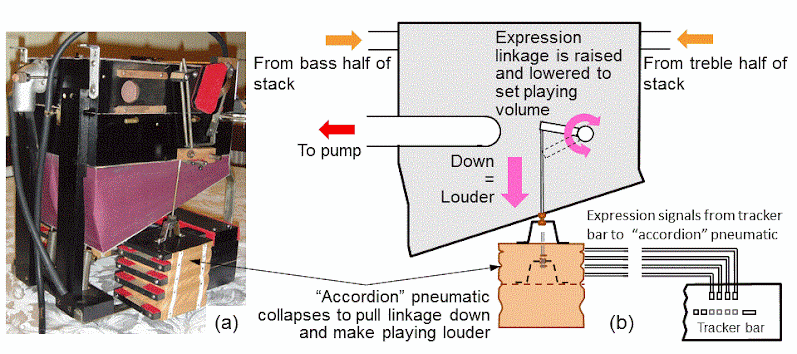
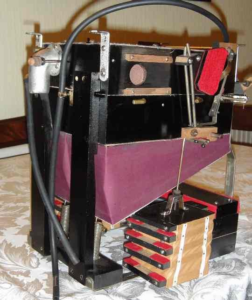 The key component of the Duo-Art system is the expression box which controls the playing of both the bass and treble halves of the player mechanism (the “stack”). It consists of two suction regulators (one for theme, one for accompaniment), each of which is operated by a lever which is pulled down via a control rod, with the movement being provided by “accordion pneumatics”, one of which is visible in the lower part of the picture. The “accordion” pneumatic has four sections which can collapse in by differing amounts (1/6″, 1/8″, 1/4″, 1/2″) to give sixteen possible combinations. This gives sixteen basic levels of playing volume. In practice, various tricks, and other features of the Duo-Art system not explored here, were used to give even more subtlety.
The following sequence of diagrams explains how the expression box works; click on the left and right arrow buttons to move forward or backward through the sequence. The sequence is best viewed on a desktop or laptop PC as it is not optimised for small screens e.g. smartphones.
Here is a video explaining in detail how the various perforations control the theme and accompaniment suction and set the expression intensity to the sixteen different levels:
The Ampico was the reproducing piano system produced by the American Piano Company, and like the Duo-Art and Welte was designed to reproduce a pianist’s actual performance which had been recorded on special equipment. The note intensity values are encoded in a combination of analogue and digital format, with separate control of bass and treble intensities. The coding consists of three binary digits in combination giving seven unique levels of intensity (not true binary code as two separat bit combinations give duplicate results), with those intensities then being increased to higher levels via slow or fast crescendo commands (and back again, slowly or fast, to the set intensity level). Ampico rolls are of standard width and spool design but have additional coding in the margins. There were actually three main variants of the full electric Ampico system (of which the Ampico A system is the only one encountered in significant numbers in the UK), with the rolls being only partially compatible between systems, and a further pedal-operated system:
The Stoddart-Ampico: this was the precursor of the Ampico A system, and is named after the inventor of the Ampico system Charles F. Stoddart. The principles are essentially the same as the Ampico A (see below) but the detailed design is different.
The Ampico A system: this is the only version likely to be encountered in the UK, and is the one described in the present explanation. It uses separate pneumatic actuators to apply forces to a lever to which is attached a suction regulator, combined with crescendo systems that modify the intensities set by the binary coding.
The Ampico B system: this uses coding similar to (but not fully compatible with) the Ampico A system, but its principles of operation are totally different and are based on the the use of a membrane valve. It will not be described here as there are very few of these instruments in the UK. A rolls will play on B players and vice versa but with some loss of musical subtlety.
The Marque-Ampico system: this was the foot-pumped version of the Ampico system and was not a true reproducing piano, being roughly the equivalent of the pedal-only Duo-Art (half Duo-Art) and was effectively a conventional player piano with some degree of automated expression. It closely resembles the Ampico A but without the crescendo system. The versions of the Marque-Ampico occasionally seen in the UK also incorporate a rather compact electrically-driven pump but as the system does not properly interpret the crescendo perforations it does not fully reproduce the performance.
The following sections explain how the Ampico system reads the notes from the roll and plays them at the level specified in the special coding in the roll margins.
How the Ampico system works
Unlike the Duo-Art expression box, the expression units in the Ampico relate directly to the bass and treble parts of the stack and are largely independent of each other, roughly as shown in the reproducing piano introduction.
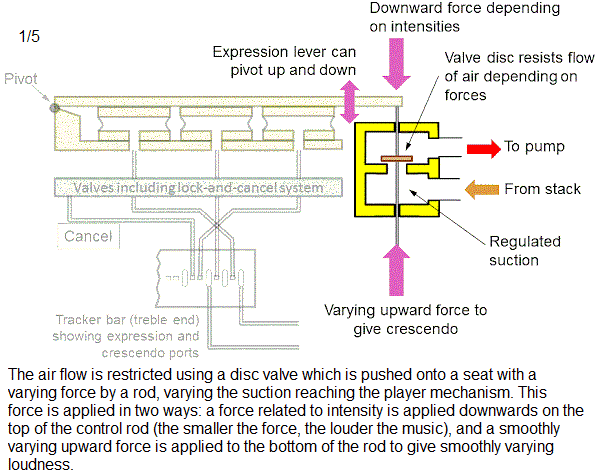
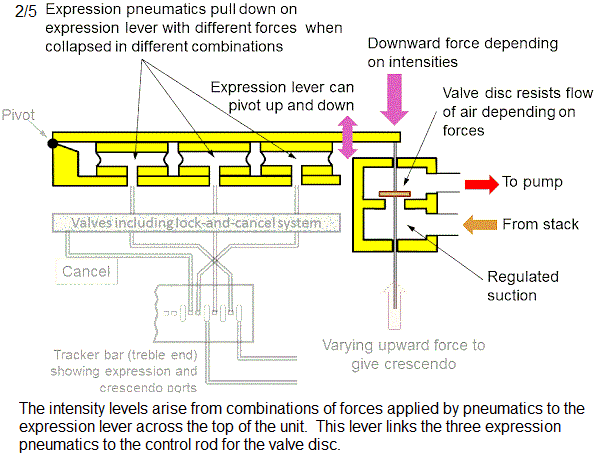
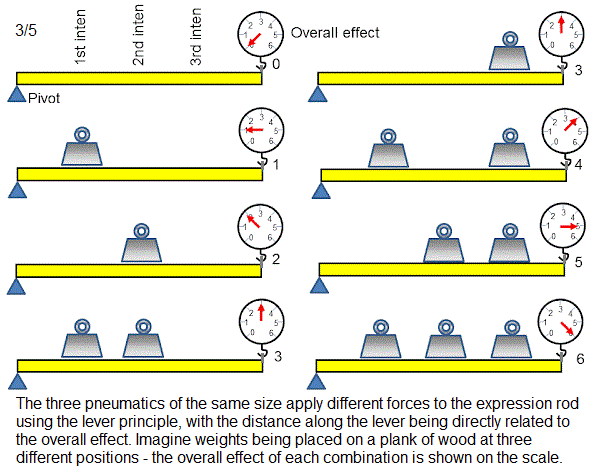
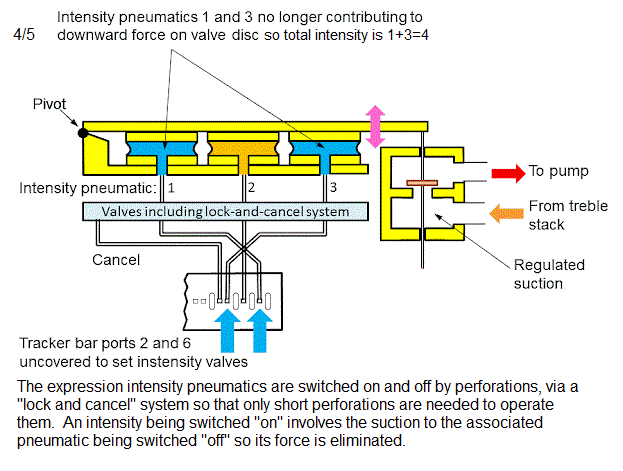
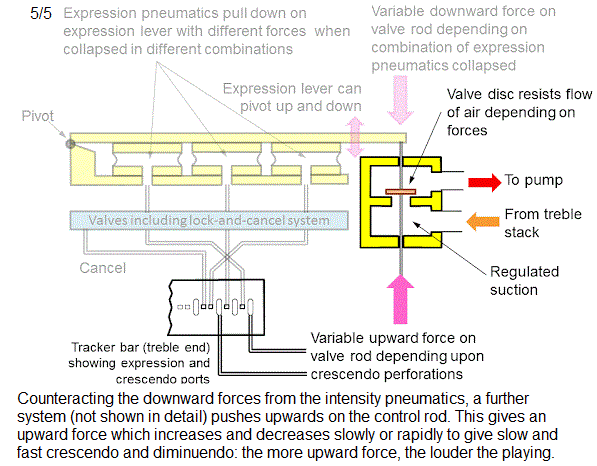
The following images show in more detail how the suction regulators forming the expression system actually work. The overall principle is that the suction to the playing mechanism (pneumatic stack) is varied by applying a combination of forces to a valve disc which tends to oppose the flow of air: the greater the downward force applied to the disc, the quieter the playing. Downward forces (released as required to build up different intensity levels of playing) are opposed by upward forces from the crescendo system; the overall force on the disc is that which determines the playing level.
One very important point which is not shown in the diagrams (for simplicity) is that the expression pneumatics are connected via their valves to the regulated suction, so there is in fact a feedback loop which results in an equilibrium level of regulated suction to the stack for each required playing level.
An in-depth article, How the Ampico Works, can be viewed in NWPPA Journal 118.
Technical Documents
This page will be populated with non-copyright technical documents in due course. In addition please note that the redrawn schematic diagrams of the Pianola, Half Duo Art and Higel player pianos are copyright 1983-1988 I A Jones, are provided here for the benefit of members and other enthusiasts and are NOT to be reproduced commercially. The original Music Trades School diagrams are also linked for comparison, noting that the reproduction quality of these original charts ranges from mediocre to extremely poor.
Please note that this information is provided in good faith and with no warranty of its accuracy or suitability.
Download A3 PDF of redrawn tubing diagram for a typical Aeolian Pianola 88-note player piano.
Download A3 PDF of redrawn tubing diagram for a pedal-only Duo-Art player piano (not the full reproducing piano).
Download A3 PDF of tubing diagram for a typical Higel 88-note player piano.